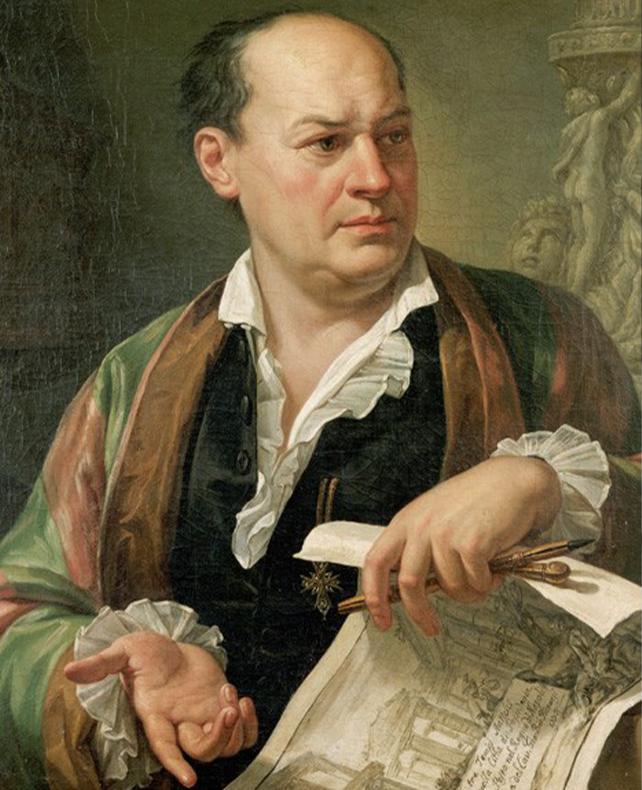
Giovanni Battista Piranesi
(b. 4 October 1720, Mogliano Veneto, Republic of Venice – d. 9 November 1778, Rome, Papal States)
Giovanni Battista Piranesi was an Italian engraver, architect, archaeologist, and architectural theorist, regarded as one of the most influential printmakers of the eighteenth century. Although he achieved international recognition primarily through his etchings, Piranesi consistently considered himself an architect, and architecture remained at the center of his artistic and intellectual practice.
Born near Venice in 1720, Piranesi was trained in architecture, structural and hydraulic engineering, perspective, and stage design. In 1740, at the age of twenty, he moved to Rome, the city that would become the principal subject and inspiration of his work. There he briefly trained with Giuseppe Vasi, one of the leading printmakers specializing in views of Rome, and rapidly developed an exceptional command of etching.
Piranesi became renowned for his monumental representations of ancient and contemporary Rome. His celebrated Vedute di Roma (Views of Rome), begun in the late 1740s and continued throughout his life, transformed monuments, ruins, bridges, squares, and archaeological remains into dramatic compositions characterized by powerful contrasts of light and shadow, exaggerated perspectives, and a remarkable sense of scale. These images played an important role in shaping the European imagination of Rome during the eighteenth century.
Among his most extraordinary works is the Carceri d'invenzione (Imaginary Prisons), a series of visionary architectural interiors composed of immense staircases, arches, bridges, machinery, and seemingly endless spaces. Through deliberately ambiguous perspectives and impossible architectural structures, Piranesi transformed architecture into a psychological and imaginative space, creating images whose influence would extend far beyond his own century.
His fascination with antiquity also resulted in ambitious archaeological publications, most notably Le Antichità Romane, published in 1756. Rather than simply documenting ancient ruins, Piranesi investigated Roman engineering, construction methods, monuments, and decorative systems, establishing himself as both an artist and an important antiquarian scholar. His work consistently defended the originality and grandeur of Roman architecture while demonstrating how the visual language of antiquity could inspire contemporary creation.
Piranesi's legacy extends across printmaking, architecture, archaeology, interior design, and visual culture. Through his extraordinary combination of historical observation and architectural imagination, he transformed the representation of space and created a visual language that continues to resonate in art and architecture today.